Welcome! This blog is dedicated to academic writing, rhetoric and media studies.
Introduction: Hello, my name is Trenten Cunningham and this is the first blog I have ever written. For me, this is a fresh learning experience, and as such, this blog is bound to evolve and change over time as I learn how to properly use it and the tools on this website.
The big reason I call this the renaissance man blog, is because it is a kind of person that I aspire to be like. I wish to be competent, and knowledgeable, in many fields, as opposed to only being good at maybe one or two things. I feel that life is too short to just focus on maybe bein good at your job and maybe a hobby, and it is better to try to be at the very least well versed in many fields while having a specialization of some kind. This way, your specialization, the one thing that you may be best at, is only made better by all the insight you have into your other interests. This is a life long process, and the idea that I will never stop learning, and that I can, if I work hard enough, become more competent in what I enjoy, is an exciting prospect.
My ultimate goal in life is to be a published author. I already write every day, and enjoy the creating process. But writing is not my only enjoyment, I am learning to play three instruments (two, if you consider a bass guitar and a standard guitar to be the same) and enjoy experimenting with synths. I enjoy drawing as well, especially ink, pencil, and fractal, and I am learning to speak six languages: Spanish, German, Russian, Japanese, Latin and of course English, because you never really do master how to speak your mother’s tongue. And when I do find the time or the chance, I will play a video game or two. RIght now I am what some might call a “retro binge” where one would play games published before the year 2000. This includes games like Doom, Wolfinstein, Metroid, and Elder Scrolls 1 & 2; Arena and Daggerfall respectively. Finally, I fancy myself an avid reader, I enjoy reading all sorts of literature, from an easy to read science fiction or fantasy novel to something maybe more complex and influential, such as the Iliad and the Odyssey, The Aeneid, the bible, Quran and Tanac and my person favorite: The Devine Comedy.
To finish things up, I also enjoy studying in fields that are not essential to my major in my spare time, mostly the STEM fields and History. I like to think that I am at least competent in the History of Rome, and its evolution through history, including the Byzentines.
Thank you for coming by!
-Trent
The First Entry:
“Many of life’s failures are people who did not realize how close they were to success when they gave up.”
-Thomas Edison
One thing that I have learned in my short time alive, it is that the difference between people who are successful and people who are not, is the perseverance of the successful. Thomas Edison once said that he was famous not for creating the lightbulb, but because he found more than a thousand ways on how not to make a lightbulb. Steven King also spent much of his young adult life having his short stories be rejected, over and over again. Marcus Aurelius’ had a frail body, but he maintained and stabilized the Roman Empire despite all his enemies and all the people around him. No one ever became successful without first facing a little adversity… at the least.
Visuals and a Purpose
Visuals: Visuals are self explanatory: it is a genre that goes over the use of visuals, like pictures, photographs, pieces of art, etc. For visuals to be useful for the author they must relate to the purpose of the writing. Visuals can also help set the tone for the writing, for example, a visual can be the image of the author, with a quote, or a piece of art that in some way relates to the writing. How it does is up to the author and relies on their skills. There is ample evidence to show that using visuals in one’s writing makes it easier to draw in potential readers. There is also ample evidence to show that most people are easier to draw in with the use of videos, spoken word, and images alongside written articles for the sake of sharing or presenting information. Individuals are much more likely to stay engaged with something if it is in video form. And in the modern era, where the average person’s attention span is shorter than ever, it is arguable that the use of visual cues is more important than ever. Because this blog is mostly focused on sharing ideas and concepts via written word, the best way for me as the author to keep attention is to use still images as well as relevant artwork and maybe personal pictures when they apply to the subject. And the subject for this and the next blog, as the title showed, is visuals and purpose.
It is also true that visuals can also take away from the writing. So the use of moving images, like .GIF files, can also take away from the subject. Distracting images, like moving ones, or bright, flashing images that may be offensive to the eyes, or even some images that do not relate in any to the blog (as I stated earlier) work against the author. In an academic blog, the author will want to use less visuals, but also more strategically placed images that if used right, will help more than hinder.
Purpose: What are you writing about? What is the point you are trying to get across? Do you have a reason for writing and why is it important to you? These are all questions the author should ask themselves when they are finding the purpose to their writing. For some, the reason can be as simple as a grade on an assignment, for others it can be the difference between getting their PH.D, MD, or other relevant documents. Others write for activism or as a means of therapy. As for me, usually I like to write because not only do I enjoy it, but I aspire to be a published author. An author should have some kind of purpose or direction in mind when they start to write. The fully flesh this out, you want to plan out how your writing will happen. For academic writing I would recommend the more common strategy of starting with an introduction, and then leading into general topics, which will all lead into the thesis statement. The thesis statement is the main point or idea of the article or essay. And the purpose you are writing. Key points should be broken down and back up with clear and concise evidence at the start of each subsequent paragraph. And finally, each paragraph should relate back to the thesis statement somehow. Tirades need to be avoided, because the risk that you will loose the purpose of your writing is very, very high. Your writing will also loose authority.

There is a big difference between authoritarian writing and authoritative writing. And a competent, firm voice is the difference between having your point be understood and having it be brushed off as irrelevant. When the author has an authoritative voice, they also have the trust of their readers. An author needs to be able to state their points clearly and be able to back it up with important points of evidence. Avoiding words like “I think” or “I believe” is a good point to start, also, using evidence from other authoritative sources like academic journals or even other academic blogs is a good place to start. The less the author refers to themselves or to the reader is also a big help in making their writing more believable. That said, there are times where speaking directly to the reader or using “I” can benefit the author. The trick is to find that middle ground where it does not read as if you are relying too much on the words.
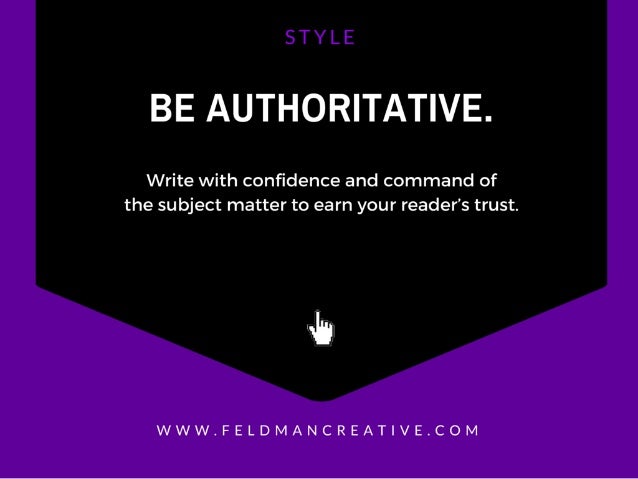
As stated earlier, there is a big difference between authoritative and authoritarian writing. With authoritative, the author is making their points clear and concise, and is making an argument. This type of writing, especially in academics, is more open to counterpoints and conjecture. This way, a writer can make a counterclaim and even become more understanding of their points and the counterpoints to their argument. Authoritarian writing is in a lot of ways the opposite of authoritative writing. Authoritarian writing leaves no room for argument for counterclaims. And as a result it destroys its own argument. When a writer leaves no room for counterarguments they end up making their own argument look much weaker as a result. And they even lose authority over the subject because they are unwilling to see different points of view or different ideas. If you are going to write an academic essay, avoid authoritarian writing, and instead be open to counterclaims. You find that you walk away from being questioned even more sure of your position.
 Modern Renaissance Man